Official data ·
Sending cash remittances from the U.S. to the Dominican Republic now carries a 1 % tax: US$2 per US$200
Since January 1, 2026, the United States has charged a 1 % tax on remittances paid with cash, a money order, a cashier's check or another physical instrument. The sender pays it, and it does not apply when the money comes from an account at a financial institution or is paid with a U.S.-issued debit or credit card. On the average remittance sent from the U.S. to the Dominican Republic in January-September 2026 (US$265.45), 1 % is US$2.65.
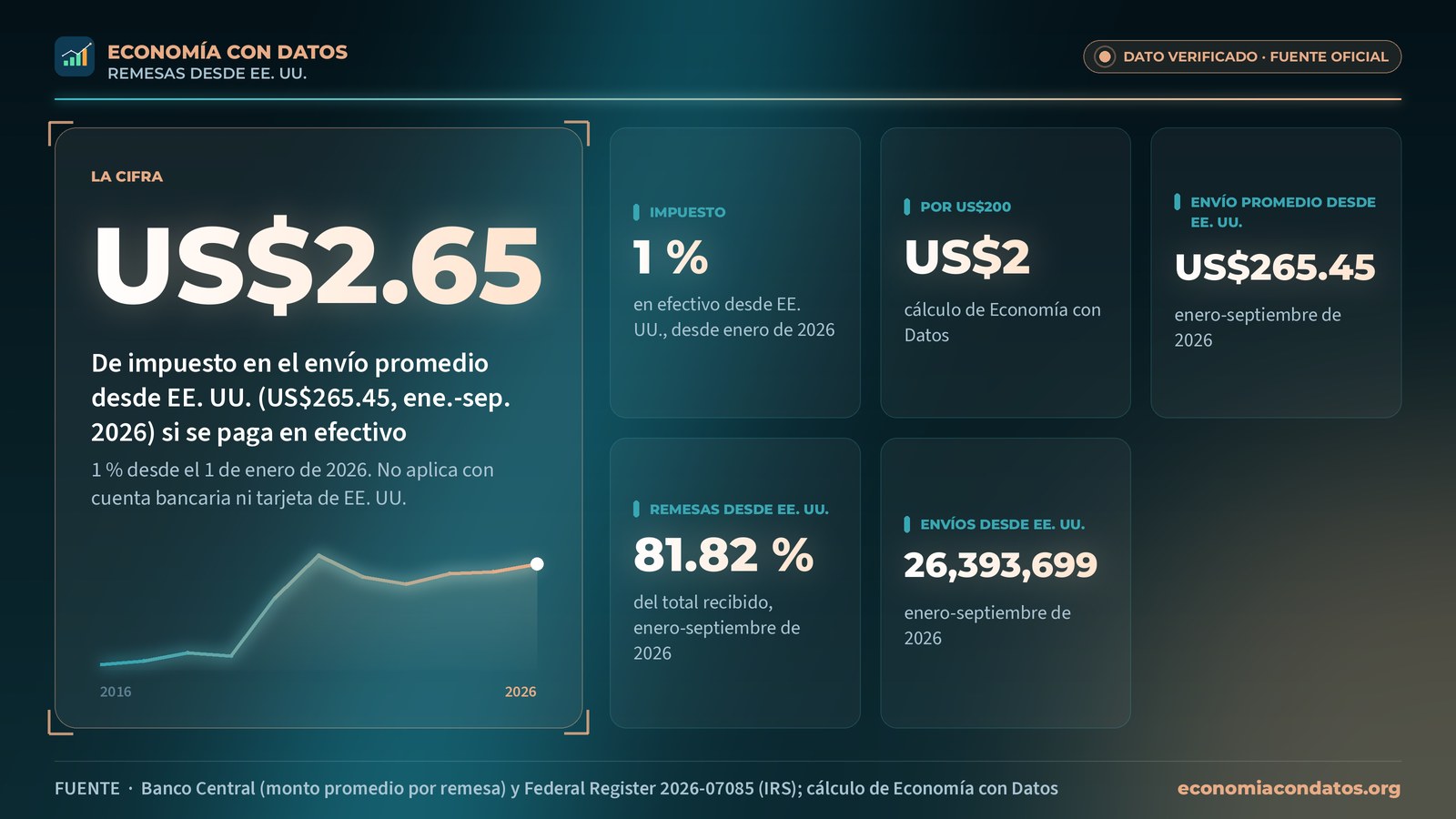
If you live in the United States and send money to family in the Dominican Republic, how you pay for the transfer changes what it costs you. Since January 1, 2026, section 4475 of the Internal Revenue Code imposes "a 1 percent tax on the amount of certain remittance transfers," according to the proposed regulations from the Internal Revenue Service (IRS) and the Treasury Department, published in the Federal Register on April 13, 2026 (document 2026-07085, REG-114499-25).
Which transfers are taxed
The tax applies when the sender gives the provider "cash, a money order, a cashier's check, or any other similar physical instrument"; the proposal adds traveler's checks. It does not apply to transfers funded from an account held at a financial institution or paid with a debit or credit card issued in the United States. The sender pays the tax; the provider collects it and remits it quarterly. It is charged on the amount transferred to the recipient and excludes the provider's fees.
How much it is
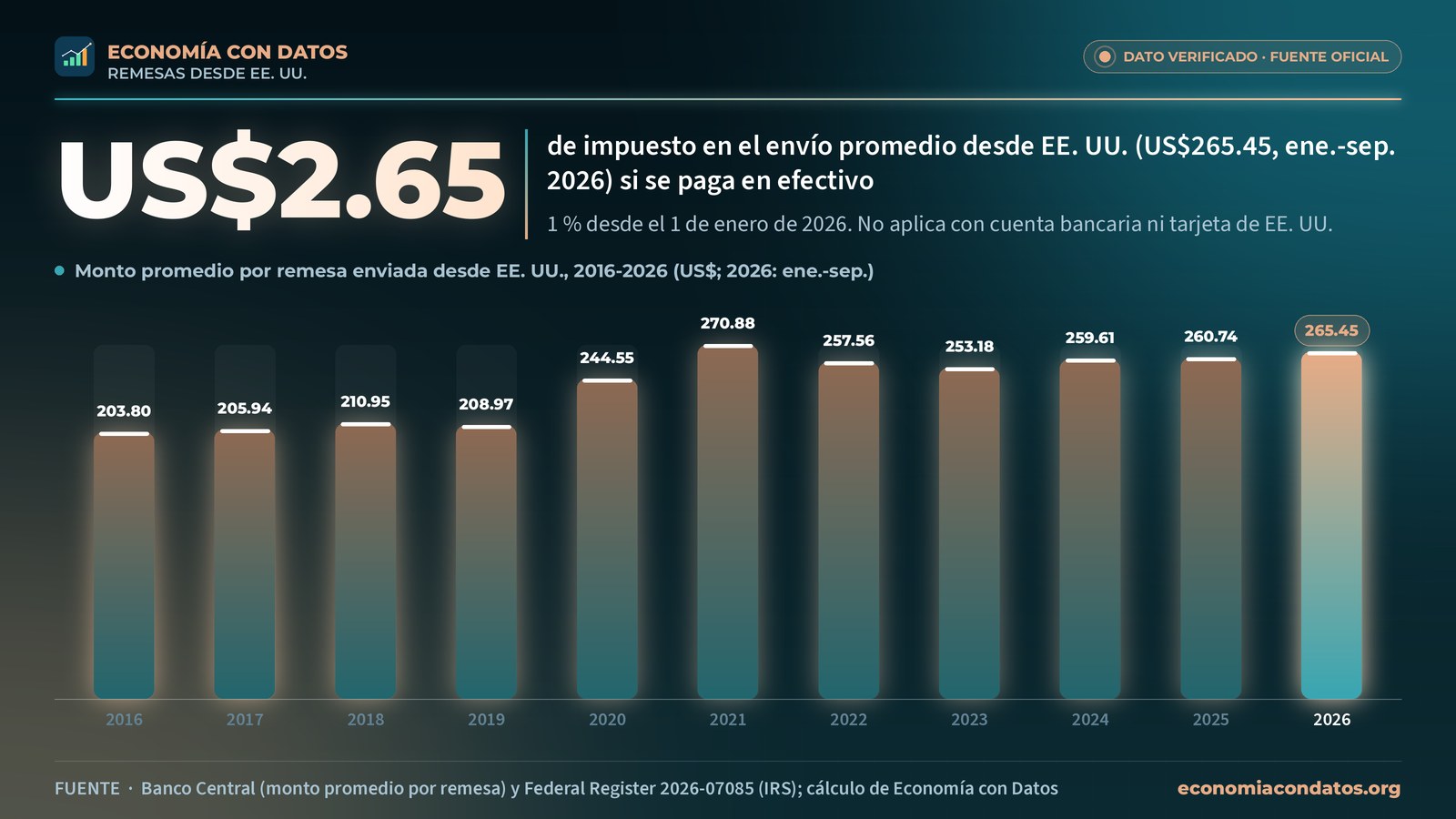
According to the Central Bank of the Dominican Republic (BCRD), the average remittance sent from the United States was US$265.45 in January-September 2026 (US$260.74 in 2025). Paid in cash, 1 % of that is US$2.65; it is US$2 per US$200 and US$5 per US$500. The United States accounted for 81.82 % of remittances received and 26,393,699 of 30,998,574 transfers (85.14 %) in January-September 2026. These are Economía con Datos calculations with data from the cited sources; the BCRD figures do not show how many transfers were paid in cash.
What it means for you
Paying in cash or by money order adds 1 % of the amount sent; paying from your bank account or with a U.S.-issued debit or credit card does not. Your family receives the amount you send; the tax is paid by you.
Source: Servicio de Impuestos Internos de EE. UU. (IRS), Departamento del Tesoro, Federal Register (document in Spanish).
This is an English summary by Economía con Datos. Read the full article in Spanish.
Get Dominican economic data on WhatsApp: follow our channel (in Spanish)